
Community
SENIOR SPOTLIGHT: Remembering the stories behind the service
By Louise Morales
Advertisement · Why this ad?
Emily Tran has been chronicling Buffalo's vibrant neighborhoods and community issues for over 10 years. She holds a degree in Journalism from Syracuse University and previously contributed to NPR’s Buffalo affiliate, where she developed a knack for storytelling that resonates with local residents. Emily’s passion for community engagement drives her to highlight the unsung heroes of Buffalo.
More from Emily →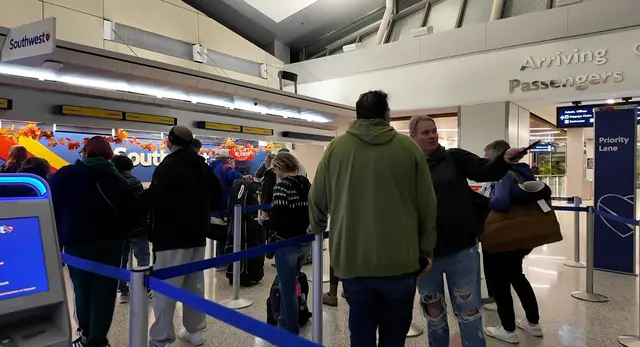
BUFFALO, N.Y. — The national ground stop may be over, but it could be some time before the aviation system gets back on track. At Buffalo Niagara International Airport, travelers were frustrated and uncertain about when they would finally be able to reach their destinations.
Earlier this week, a nationwide ground stop threw travel plans into chaos, leaving passengers waiting for answers as delays and cancellations disrupted flights. For some, the uncertainty was enough to reconsider traveling altogether.
The ground stop, officially lifted at 8:19 p.m. ET, stemmed from “instability” in telecommunications impacting air route traffic control centers. Transportation Secretary Sean Duffy explained that while not a complete loss of communication or radar, the instability necessitated a precautionary measure to ensure safety. The Federal Aviation Administration (FAA) initially issued an advisory halting all departures from airports nationwide. This was the first such nationwide ground stop since January 2023, and only the second since the aftermath of the September 11th attacks. The root cause, according to officials, lies in aging infrastructure within the air traffic control system, with routers experiencing overload and delivering inconsistent data.
The situation has been declared a national emergency, prompting efforts to update the country's air traffic control systems. While officials have found no evidence of a cyberattack, they are not ruling out that possibility as investigations continue. The disruption impacted not only domestic flights but also international travel, with Europe suspending all U.S.-bound flights. The FAA’s advisory stated: “Due to extraordinary circumstances and for reasons of safety. Attention all aircraft operators, by order of the Federal Aviation Command Center, all airports are ground stopped. All departing traffic should remain ground stopped until further notice. Inbound international flights will be managed on a case-by-case basis.”
The ground stop itself is a serious measure, distinct from a ground delay which simply manages traffic volume. A ground stop halts all departures, creating a ripple effect across the aviation network. While flights were able to land during the stoppage, the backlog of planes waiting to depart created significant congestion and delays.
Passengers at Buffalo Niagara International Airport expressed a range of emotions, from frustration and uncertainty to a determination to find alternative ways home. Ever Miranda, traveling for work and worried about missing her little sister’s birthday, lamented, “I might miss my little sister’s birthday.” David Brown, overwhelmed by the uncertainty, confessed, “I am just going crazy here. I need to eat, and I don’t want to go inside yet because I don’t want to be stuck in one place.” The anxiety was palpable as travelers grappled with canceled plans and the possibility of extended delays.
Faced with the prospect of indefinite waiting, some travelers made the difficult decision to abandon their flights and seek alternative transportation. Adam Vanbrekel opted to drive, stating, “I want to get back home, and then I know I’ll guarantee I make it there rather than guessing.” Dylan Wood and his group followed suit, explaining, “We didn't want to just sit and wait and not really have an answer on when we can actually depart, so just a group decision that we just decided to drive.” These individuals faced a potentially grueling journey, with some anticipating over 20 hours on the road.
Airlines across the country issued travel waivers to provide passengers with flexibility in changing their plans. American Airlines stated they had issued a waiver allowing customers to change travel plans free of charge, while United Airlines offered similar accommodations through its website and app. These waivers aimed to ease the burden on travelers facing disrupted itineraries and offer some measure of relief in a chaotic situation.
While the ground stop has been lifted, the aviation system faces a long road to recovery. Delays and cancellations are expected to persist as airlines work to re-accommodate passengers and clear the backlog of flights. Passengers scheduled to fly Saturday are strongly encouraged to check with their airlines before heading to the airport. The immediate focus is on restoring normal operations, but the underlying issues that triggered the ground stop – aging infrastructure and potential vulnerabilities – demand long-term attention.
The declaration of a national emergency underscores the urgency of modernizing the nation’s air traffic control system. Federal officials are working to address the root causes of the communication instability and prevent similar disruptions in the future. This will likely involve significant investment in new technology and infrastructure upgrades, as well as a review of existing protocols and procedures.
Beyond the immediate crisis, this event serves as a stark reminder of the importance of stability – not just in our infrastructure, but in our lives. Strong marriages and families provide a bedrock of support during times of uncertainty. While modern technology offers incredible convenience, it also introduces new vulnerabilities. As we navigate an increasingly complex world, it’s vital to prioritize the values that have always sustained us: faith, family, and a commitment to building strong communities. The questions that linger now are: How can we ensure the safety and reliability of our critical infrastructure? And how can we, as individuals and as a community, cultivate the resilience needed to weather future storms?
I hope that this experience encourages us to appreciate the simple blessings in life – the ability to travel safely, the comfort of home, and the presence of loved ones. And I pray that we learn from this disruption, working together to build a more secure and reliable future for all.
For passengers with upcoming flights, the following resources are available:
Amtrak's website and app experienced errors during the ground stop, but travelers seeking alternative transportation may find more information at Amtrak.
The events of Friday evening serve as a powerful reminder of the interconnectedness of our world and the importance of preparedness. While the immediate crisis has passed, the long-term implications – both for the aviation industry and for our understanding of infrastructure resilience – will continue to unfold in the days and weeks ahead. The hope is that this experience will spur meaningful action and lead to a safer, more reliable air travel system for all.
White Plains, New York
Community
Saturday, November 14, 2026
5 min
By Louise Morales

By Emily Tran

By Nina Rodriguez

By Amira Bell